Your perception team is relabeling last spring’s intervention events, the moments when a remote operator had to take over because the model’s output fell below its confidence threshold and the robot stopped. They need the raw recording of the incident. When your team goes to pull it, they find that a lifecycle rule got there first. During a recent budgeting review, someone wrote a rule to expire raw data after 90 days, and at the time, it seemed like responsible housekeeping.
That’s the bind many data infrastructure teams find themselves in. As data grows, storage starts to be a bigger line item subject to budget review every quarter. While the storage budget rewards deleting data, the model team’s needs can surface months later. The budget usually wins, and this cost shows up in model training and re-training.
Get the White Paper
Every deployment captures something your next model could learn from. Learn how to retain valuable video and sensor data, keep it accessible across GPU providers, and manage storage costs as your fleet grows.
Why edge cases are the retention problem
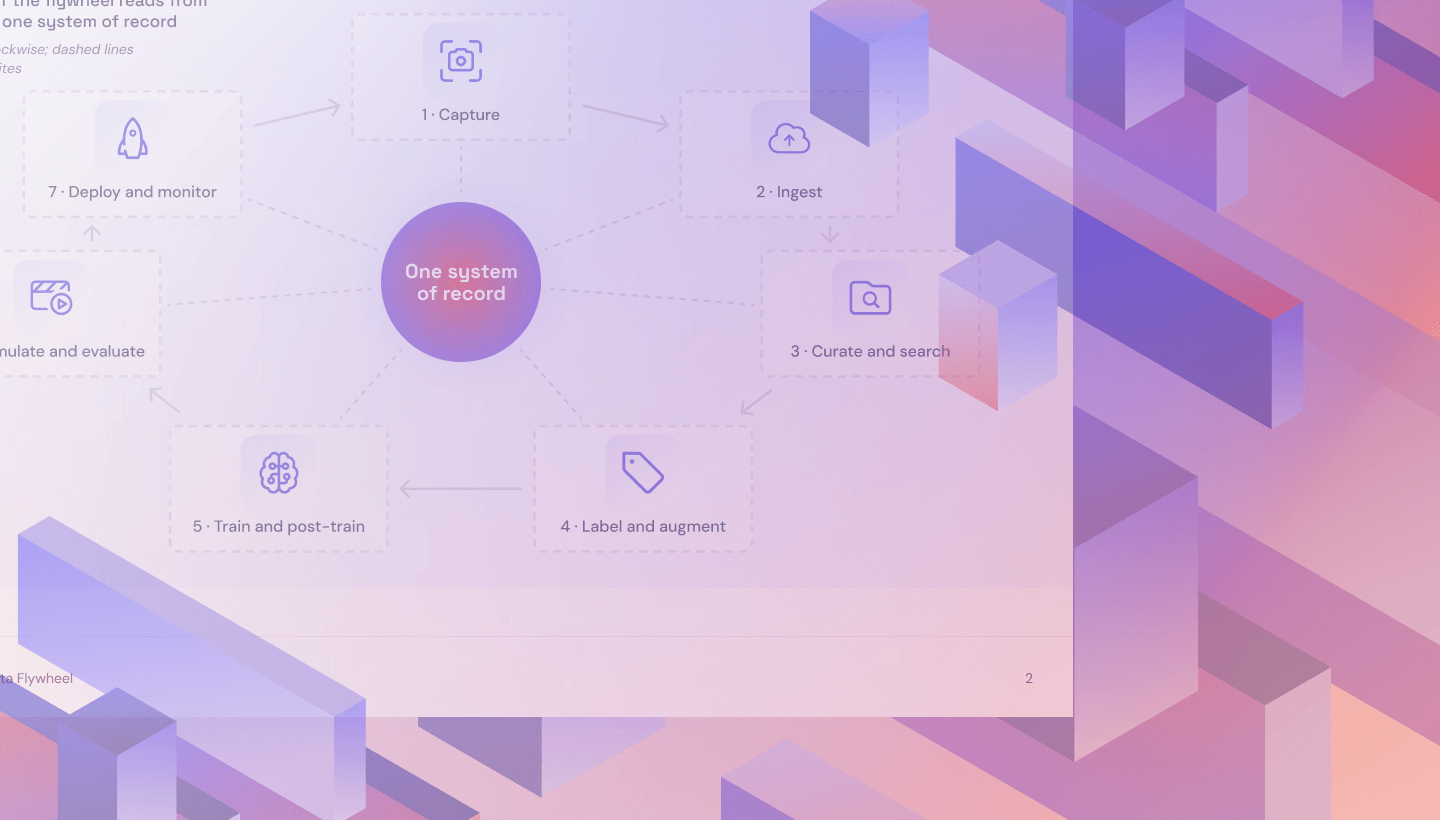
Fleet learning runs on a data flywheel: field data becomes training data, which produces a better model that ships back to the fleet. Those needs arrive late because of how physical AI learns and improves. It does so through the data flywheel, that ongoing loop that turns field data into training data.
What does that look like in practice? A robot meets something its model hasn’t seen, such as a row of boxes blocking a pallet that needs to be unpacked. The robot attempts to find an alternate route to unpack the pallet until it stalls and fires an alert that notifies the floor associate. The human in the loop takes over remote operation to assist the robot in manually moving a couple of the boxes and placing them to the side so the pallet is accessible. The recording of that moment goes home, gets labeled, and joins the training set for the next model, which ships back to every robot in the fleet, so the next robot that encounters a similar situation can handle it on its own. Each turn of the flywheel makes the fleet a little more capable, and the fleet’s own mistakes supply the raw material for the next revolution.
This loop runs on edge case training data: recordings of situations a model handles poorly or has never seen. Those events are rare by definition, and they can sit untouched for months before a labeling pass or a new model needs them, which is exactly the window in which retention decisions do their damage. Most of those edge cases aren’t lost due to a deliberate choice. They disappear through decisions nobody recognized as retention decisions at the time they were made, which is why, although most teams treat it as a line item in the storage budget, retention policy actually ends up dictating what the next model can learn.
Where edge cases get lost on the robot
Many edge cases are lost before they ever leave the robot, either to a buffer that overwrites them or to an upload trigger that never fires.
- Rolling buffers. Onboard flash sets the window, not the time it takes an operator to flag an odd event. A clip reported three days later is often already overwritten.
- Confidence-based upload triggers. These are discard rules. They send home frames where the model was unsure and drop frames where it was confidently wrong.
- Anomaly-only triggers. An anomaly needs a baseline. A fleet that uploads only outtakes has no record of normal operation around them. Add a small, steady sample of routine footage to the capture policy.
Triggers that fire only on anomalies create a quieter problem, because an anomaly only means something next to a baseline. A fleet that never uploads an ordinary day’s operation ends up with a library of outtakes and no record of what normal looked like around them. So a small, steady sample of routine footage should be included in the capture policy too.
Why the raw recording is the deletion you can’t undo
Labels, curated datasets, and checkpoints can all be rebuilt with labeling hours or GPU time. The recorded moment can’t be recreated. Keeping raw recordings supports continuous learning for AI models by giving teams source material they can revisit as labels, architectures, and training methods change.
Some deletions are correct. Preprocessed tensors, auto-label passes, and unread caches are cheap to regenerate. The failure is a rule that can’t tell a cache from a recording and expires both on the same schedule.
The subtler mistake is keeping derived data and dropping the raw. Labels encode today’s taxonomy and today’s model input format. Raw video can answer questions you haven’t asked yet. Foundation-model pretraining is moving toward large-scale video: NVIDIA’s GR00T N1.7 reportedly added 20,000+ hours of human egocentric video to pretraining, and public datasets like DROID and Open X-Embodiment show the field pooling raw trajectories across robots and labs. If you later want to pretrain or fine-tune on your own fleet’s video and the raw is gone, your hardest cases survive only as bounding boxes for a retired model.
How pricing makes retention decisions for you
Storage pricing forces retention decisions of its own, mostly through cold tiers and per-request fees. Tiered storage saves money on data nobody is likely to touch again. Edge cases are the opposite, since teams come back to them without warning: when a model regresses, when the architecture changes, or when someone asks what a robot saw on a particular afternoon. Retrieval delays, retrieval fees, and minimum storage durations attach a cost to every one of those returns, so data that technically still exists quietly stops getting fetched. Cold storage is deletion with a longer goodbye.
Per-request fees work on the other end of the pipeline. Fleets that upload events as they happen, rather than in bulk at the depot, produce a steady stream of small writes from hundreds of devices, and when every write carries a charge, teams batch more aggressively and set their triggers to fire less often. Nobody decides to capture fewer edge cases, but the bill makes that decision for them, one adjusted threshold at a time.
When discarding at the edge is the right call
Discarding at the edge is the right call when the environment rarely produces anything new. A warehouse robot repeating one task in a highly controlled environment can process what it sees on the device and keep only telemetry and task events. Fleets on sidewalks, public roads, or farmland don’t have that luxury, because the world is dynamic, always inventing situations their models haven’t seen.
- Static environments. A warehouse robot repeating one task in a controlled space can process on-device and keep telemetry and task events.
- Dynamic environments. Fleets on sidewalks, roads, or farmland keep meeting novel situations, but even there, most footage is ordinary work. An archive with no capture policy grows several times larger with little added training value.
- Privacy and regulation. Robots recording in homes and workplaces carry exposure on every retained hour. Raw footage also supports safety reviews and liability investigations, which argues for keeping the clips that might matter.
Where Backblaze fits
The tension between the budget and the model eases once keeping data stops being the expensive choice, and Backblaze B2 Cloud Storage removes the pricing pressures that push teams to delete with:
- Single hot tier. Last spring’s recording is readable immediately, with no restore request or thaw period.
- No retention minimums. Keep generously and expire later without paying for deleted data.
- Unlimited API calls, no upload fees. Tune capture triggers for data quality, not request counts.
- S3-compatible. Existing offload tools and training pipelines point at it without code changes.
Want to dig deeper? The Physical AI Data Flywheel white paper follows a single edge case through every stage of the loop, from capture to redeployment, with the sizing math and open-source sample pipelines you can run yourself. Download the white paper.
Frequently asked questions
What is the physical AI data flywheel?
The physical AI data flywheel is the loop that turns experience in the field into better models. Robots capture data during operation, teams select and label relevant examples, and those examples inform training and evaluation. Updated models return to the fleet, where new encounters supply data for the next iteration.
Why does data retention matter for physical AI?
The value of a recording may become clear months after capture, when a model regresses, a labeling taxonomy changes, or a new training approach needs different inputs. If a retention rule has already deleted the raw data, teams lose the opportunity to revisit that event. Retention policy helps determine what future models can learn.
What data should physical AI teams keep?
Prioritize raw recordings of interventions, failures, novel situations, and other events that could support training or safety reviews. Keep enough surrounding context to interpret each event, along with relevant sensor metadata and a representative sample of routine operation. Set retention periods according to learning value, reproducibility, cost, and privacy obligations.
Are confidence-based upload triggers enough to capture edge cases?
No. Confidence-based triggers can capture moments when a model recognizes uncertainty, but they can miss confident mistakes. Combine them with other signals, such as operator interventions, task failures, and periodic sampling. Size onboard buffers to give teams time to flag and retrieve events before recordings are overwritten.
Why keep raw recordings after labeling?
Labels reflect the questions and categories a team uses today. Raw recordings let teams apply new labels, investigate failures, and prepare inputs for different models later. Derived artifacts can often be regenerated if their source data and processing details remain available. A deleted recording of a real-world event cannot be recreated exactly.
Is cold storage suitable for physical AI data?
Cold storage can suit recordings with infrequent access and acceptable retrieval delays. It becomes less useful when teams need unpredictable access for regression analysis, relabeling, or training. Compare the full cost—including retrieval charges, minimum storage durations, and engineering time—with keeping selected recordings immediately accessible.